
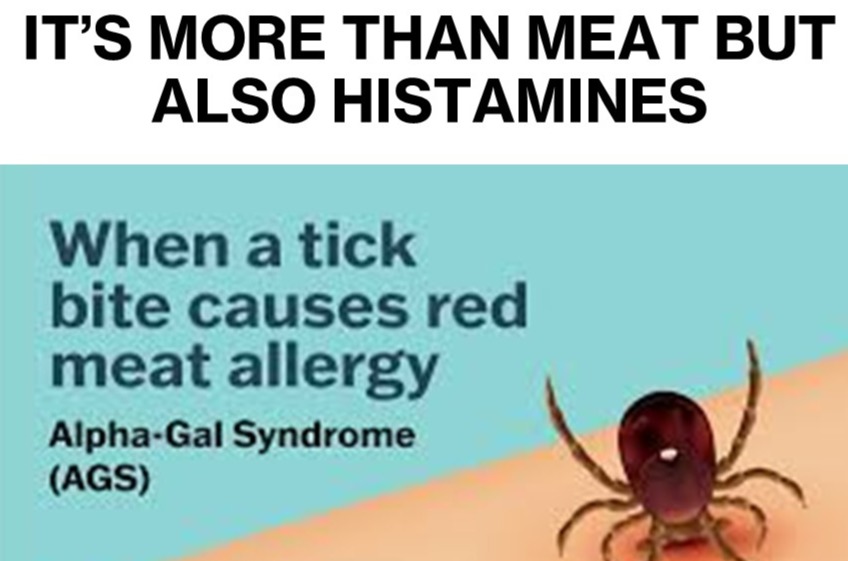
It turns out Alphagal is not just about four legged creatures and dairy products but also histamines! I have done extensive research, called around to various medical professionals, on WHY I continue to be congested, have headaches and fever even after curbing my diet. Turns out I’m eating ALL histamine foods. I will refrain from eating these foods for 30 days and then reintroduce them one at a time. The final pages contain foods to be avoided that contain histamines.
Stop eating mammalian meat
Many people with AGS can tolerate some mammalian products, like dairy, but virtually everyone with AGS needs to stop eating the mammalian products listed below, even if they have only had mild reactions, because:
- Reactions to alpha-gal are highly variable and dependent on cofactors. Therefore, a future reaction could be more serious.
- Alpha-gal syndrome is “an anytime allergy, not an every time allergy.”
- Up to 60% of people with AGS have anaphylactic reactions (1-4), and 30-40% of us experience cardiac symptoms.
Don’t play Russian roulette!
Some, but not necessarily all, foods to avoid include:
- The internal organs of mammals, like liver, heart, intestines (tripe or offal), lungs, and kidneys, which contain even more alpha-gal than meat
- Some people who don’t even react to meat have anaphylactic reactions after eating organs.
- Mammalian meats, like beef, pork, lamb, bison, venison, goat, horse, rabbit, squirrel, kangaroo, antelope, buffalo, camel, guinea pig, bats, whales, etc.
- If you aren’t sure which animals are mammals, there is a guide here.
- All other mammalian tissues, cells, and fluids, like brain, nerves, bones, skin, and blood
- Meat broths, bouillon, stocks, and gravy
- Meat flavorings, which are often just listed as “natural flavor”
- Meat extracts
- Mammalian gut sausage casings (turkey and chicken sausages often have these)
- Removing the casing and eating the sausage without it is not advised, as severe reactions have occurred from this practice.
- Animal fat, like lard, tallow, and suet are often in cooked foods, such as gravies, sauces, pastries, pie crusts, tortillas, refried beans, baked beans, vegetable dishes, mashed potatoes, and desserts added to fry oil to enhance flavor.
- Other products containing mammalian meat or organs
- Also, be cautious with high-fat dairy & large amounts of butter (57)
- Read labels!
- When eating out, you must ask about the mammalian content of anything you order. In particular, be sure to ask about gravies, sauces, stocks, and fry oil used to fry chicken, french fries, and other foods.
- It helps to have a card with information explaining which foods and ingredients you can’t eat to share with wait staff and chefs at restaurants. You can download one on this page.
Be aware that avoiding these products may not be enough. Many people with AGS react to other mammalian products like rennet, milk, dairy products, and gelatin. Some also react to mammalian byproducts and/or carrageenan in food, medications, medical products, personal care and household products. There are also accounts of people reacting to flounder eggs.
- See Food: First Steps for more information.
Learn about anaphylaxis and epinephrine autoinjectors
The overwhelming majority of people with AGS need to carry epinephrine autoinjectors (like EpiPens)
- Up to 60% of patients with AGS have anaphylactic reactions (1-4).
- Alpha-gal allergy reactions are highly variable. This variability is a hallmark of AGS.
- Cofactors profoundly influence alpha-gal allergy reactions (see above).
- New tick bites can make you more reactive, and about half the time, people don’t notice that they were bitten by a tick.
- For all these reasons, even if you have had mild reactions in the past, you could have a more serious one in the future.
Epinephrine Autoinjectors
- There are different types of epinephrine autoinjectors. Generic epinephrine autoinjectors are substantially cheaper than EpiPens.
- One popular brand of epinephrine autoinjector is Auvi-Q. If you qualify, you can get up to 2 free Auvi-Q dual packs (that’s four autoinjectors in total) a year, delivered to your house. Your doctor will need to call in the prescription. For details, see this website.
- Your doctor should show you how to use your epinephrine autoinjectors when they give you your prescription.
- As soon as you get your prescription, take it to your pharmacy to be filled. There is often a shortage of epinephrine autoinjectors. It may take time for your pharmacy to fill your prescription.
- As soon as you have your epinephrine autoinjectors, review how to use them. Don’t wait until you have a reaction.
- This video shows how to use different brands of epinephrine autoinjectors.
- Keep your epinephrine autoinjectors with you at all times.
- Can’t afford an epinephrine autoinjector? Get help here.
Anaphylaxis Emergency Care Plans
- Your doctor should also create a Food Allergy & Anaphylaxis Emergency Care Plan for you that includes instructions on when to use your autoinjectors and explain it. Share the plan with your family and keep it with you.
- This is important. Ask for the care plan. If your doctor didn’t give you one at your appointment, contact them and ask for one.
Educate yourself about anaphylaxis
- The anaphylaxis section of the FARE website is a good place to start.
- This article, All About Epinephrine: What It Does in a Reaction, How Long It Lasts, When It Gets Hot or Cold will answer many of your questions about the use of epinephrine autoinjectors.
- This video presentation about anaphylaxis and the use of epinephrine autoinjectors, featuring prominent allergist Jonathan Spergel, is packed full of information. Everyone who has anaphylactic reactions should watch it. You will feel well-informed and more confident about taking control of your reactions if you do. Click here.
- Take this short course about Recognizing and Responding to Anaphylaxis and ask your loved ones to take it, too.
Create an emergency kit
Seek your physician’s advice about the contents of your personalized emergency kit. You might want to include:
A bag to keep the kit in
- Many people like to keep their kit in a brightly colored, well-labeled bag or backpack that will be hard to overlook in an emergency.
- Add a tag to your bag indicating that you keep your epinephrine autoinjector in it.
Medications
- However many epinephrine autoinjectors that your doctor thinks you should keep with you, in a bright, insulated bag, like this one
- Whichever antihistamines, inhalers, steroids, and other medications your doctor recommends you keep with you
Mask, if needed
- An N99 mask, if you react to airborne particles and your doctor recommends one. Many people with AGS like Cambridge Masks.
Your information
- Your Anaphylaxis Emergency Care Plan
- Your medical information, including any medical history that might be relevant to your medical care
- Contact information for your emergency contact and allergist and/or primary care provider
- Your medical power of attorney, in case you are unconscious when you arrive at the hospital
AGS information
- AGS information–consider printing and carrying these papers with you, or add a link to them in your RoadID or MedicAlert file:
Don’t forget about ticks!
- If you expect to be in an area with ticks, include a magnifying glass, something to remove ticks with. If you choose to send any ticks you remove to a lab to be identified and/or tested for tick-borne disease-causing pathogens, then also something to store the removed ticks in– like tape and a plastic bag.
Beware of airborne alpha-gal
There are no published data on the percentage of people with alpha-gal syndrome (AGS) who react after exposure to airborne alpha-gal, but the informal estimates of experts range from 10-30%. People with AGS who react to airborne alpha-gal report that reactions often start within minutes of exposure, progress quickly, and can be severe.
- Suspended droplets and aerosols of fat in smoke or fumes from cooking meat, especially from grills, barbeques, and sometimes frying meat, are by far the most commonly reported airborne trigger of alpha-gal reactions.
- Until you know whether you react to airborne alpha-gal, exercise caution around possible sources of exposure, especially barbecues and other types of cooking that generate aerosolized mammalian fat.
- If you experience dizziness, breathing difficulties, or other symptoms, remove yourself immediately from the source of exposure!
- Some people with AGS report that fume reactions are the most dangerous reactions that they experience, leading rapidly to anaphylaxis, airway issues, and/or unconsciousness.
For more information about reactions to airborne alpha-gal, including reported symptoms other sources of airborne alpha-gal that may trigger reactions, see Reactions to Airborne Alpha-gal.
Learn about cofactors
Cofactors are conditions that can change how people respond to an allergen, lowering the threshold at which they react. Cofactors play an important role in alpha-gal allergic reactions. For example, if you have a glass of wine with dinner or go jogging after lunch, you are more likely to react any alpha-gal you consumed during your meal. Some cofactors include:
- Alcohol consumption
- Exercise
- The use of NSAIDs (like Advil)
- ACE inhibitors/β-agonists
- Illness, infection
- Stress
- Lack of sleep
- Menstruation
Alcohol consumption and exercise are especially important cofactors.
Tick bites aren’t cofactors, but new tick bites can also make reactions more severe.
Enter medical information on your phone
- Many first responders know to check for this.
- If you have an iPhone, you can put medical information in the iPhone Health app, which comes with your phone.
- If you have an Android phone, you can get the Medical ID app.
- You can also create a lock screen on your phone with medical information on it.
- Ideas about what to include on your phone vary from person to person. Seek your physician’s advice.
If you can, make an appointment with an allergist with expertise in AGS, even if you have to travel to see them. Many patients highly recommend Dr. Scott Commins at UNC and Dr. Jeffrey Wilson or Dr. Thomas Platts-Mills at UVA.
If you don’t live near an expert, find a local allergist with some knowledge of AGS. You may need someone local in an emergency, even if you have seen an expert. If you can’t find a local provider who understands AGS, don’t despair: find a doctor open to learning with you. There are now two excellent papers about the diagnosis and management of patients with AGS (see step #2) that can quickly get any physician willing to read them up to speed.
Figure out your alpha-gal tolerance level
Learn about symptoms
Before you try to figure out your personal tolerance level for alpha-gal make sure you understand the full range of symptoms that AGS can be associated with. People often find that GI issues, arthritis, fibromyalgia, migraines, and other symptoms that they have suffered from for years clear up once they have settled into an appropriate avoidance diet. This sometimes involves removing more than red meat from their diet.
Figure out your tolerance levels
- Learn about alpha-gal tolerance levels and figure out yours using Alpha-gal Tolerance Levels (coming soon!) for guidance.
- Then make the necessary changes to your diet, medications (with the advice of a physician), and environment.
See Determining Your Tolerance to Alpha-gal: First Steps for more information.
Avoid new tick bites and bee stings
- Additional tick bites can resensitize you to alpha-gal and make your reactions worse.
- Bee, wasp, and hornet stings may also lead to increased alpha-gal IgE.
- Consider buying some socks and other clothing from Insect Shield or have them treat some of your own clothes.
- See Avoiding Tick Bites
*The owner of this website does NOT benefit in any way from endorsing Insect Shield or any other company. The only reason we ever recommend a company is because we like their products.
Try emu, ostrich, GalSafe pork, and other great red meat alternatives
Emu and ostrich
If you eat meat, try emu or ostrich. Many people with AGS find that emu or ostrich makes an excellent substitute for beef.
- Emu and ostrich look and taste like beef. Many people can’t tell the difference.
- Emu is high in iron and low in saturated fats.
- In the U.S., many people with AGS order emu and ostrich from Amaroo Hills Emu Farm.
- One of the owners of this farm has AGS, and they are careful to avoid cross-contamination.
- Their meats are top quality and served in high-end restaurants across the country.
- They also make excellent duck products.
Galsafe Pork
Revivicor has created a special genetically-modified pig that does not make alpha-gal, called the GalSafe pig. Limited quantities of GalSafe pork products are available through Amaroo Hills Emu Farm.
Please remember that other pork is NOT safe for you! GalSafe pigs are very special, genetically modified pigs.
Duck, chicken, and turkey bacon.
An excellent substitute for pork bacon is duck, chicken, or turkey bacon.
- D’Artagnan Duck Bacon is popular in the alpha-gal community.
- If you are sensitive to alpha-gal, you may want to avoid Oscar Mayer turkey bacon, which is made on the same line as their pork bacon.
Turkey hotdogs
Sausages
- Make sure poultry sausages do NOT have mammalian gut or collagen casings.
- Some popular casing-free poultry sausages include:
- Applegate Chicken and Sage Breakfast Sausages
- Amaroo Hills Duck Breakfast Sausage (maple or regular)
- Amaroo Hills Duck Italian Sausage (spicy, sweet, and mild)
- Amaroo Hills Duck Chorizo
Turkey ham
More suggestions
- Find more red meat alternatives here.
*The owner of this website does NOT benefit in any way from recommending any brands or companies. We do NOT accept gifts, discounts, or anything else from companies mentioned on this website. We only ever recommend a brand because we like it or it is popular with others in the alpha-gal community.
Alpha-gal in Foods
Mammal-Derived Foods and Food Ingredients
Mammalian meat, organs, and other parts of mammals
These include some of the riskiest sources of alpha-gal. Examples include, but are not limited to:
- Mammalian meats (1), such as beef, pork, lamb, bison, venison, goat, horse, rabbit, squirrel, kangaroo, antelope, buffalo, camel, guinea pig, bats, whales, etc.
- If you are not sure which animals are mammals, there is a guide here.
- The internal organs of mammals, like liver (21), lung, heart, intestines (tripe), sweetbreads, and kidneys (6,57)
- Mammalian gut sausage casings
- Mammalian fat, like lard, tallow, and suet
- Mammalian fat is often in cooked foods, such as sauces, pastries, pie crusts, tortillas, tortilla chips, refried beans, baked beans, vegetable dishes, mashed potatoes, and desserts.
- Some baking mixes (like Jiffy Corn Muffin Mix) contain lard.
- Beef fat is often added to fry oil to enhance flavor (6,57).
- Bones and bone marrow
- Testicles (Rocky Mountain or prairie oysters)
- Mammalian collagen (e.g. beef collagen sausage casings) (6,57)
- Meat broth, bouillon, and stock (6,57)
- Gravy (6,57)
- Mammalian blood, found in soups, black pudding, blood sausage, blodplättar, and other foods
- Meat extracts, like Bonox and Bovril
- All other mammalian body parts, organs, tissues, cells, and fluids, such as tendons, brain, heart, nerves, skin, mammalian bile (Papait seasoning), and the products that contain them.
Most of the foods on this list should be avoided by everyone with alpha-gal syndrome. Many of us need to avoid all of them.
Rennet
Rennet is a complex set of enzymes that is used in the manufacture of some foods, such as cheese. Most rennet is extracted from the stomachs of ruminant mammals, although sometimes vegetable and microbial rennets are used. Some people with AGS can eat dairy products, as long as they don’t contain rennet from mammals.
Milk, other dairy products, and foods that contain them as ingredients (1,6,57,115)
Ten to fifty percent or more of people with AGS react to dairy products, especially those high in fat, like ice cream (6,57,85). A list of dairy products can be found here.
Gelatin and foods that contain gelatin (6,27,28,57)
Fewer than 10% of people with AGS react to gelatin in foods, although many more may have severe reactions after other types of exposure to gelatin, such as the intravenous administration of gelatin-based plasma volume expanders or gelatin-containing vaccines administered via intramuscular injections (6,57).
Natural flavors or flavorings
These are often beef or pork (57) and need to be avoided by many people with AGS. To find out whether the “natural flavors” in a product are derived from a mammal, contact the manufacturer. However, in the U.S., manufacturers are under no legal obligation to disclose the identity of ingredients that they call “natural flavors or flavorings.” Often, when asked, they will not disclose whether are derived from mammals or not.
Mammalian byproducts
An untold number of foods, especially processed foods, contain mammalian byproducts. There are hundreds of these byproducts often with obscure names, like oleic acid and monoglycerides. As of now, there is no comprehensive list of mammalian byproducts added to food in the U.S., much less information about their alpha-gal content. Most people with AGS do not react to mammalian byproducts in food, but some do (6,57), and severe reactions have documented (29). Some mammalian byproducts may not contain alpha-gal at all. Further research is needed to determine alpha-gal content and safety of mammalian byproducts for people with alpha-gal syndrome (6,57). See our guide to mammalian byproducts here.
Cross-contamination
Some people with AGS react if their food is cross-contaminated by foods that contain alpha-gal, for example, if their poultry or seafood is cooked on a grill used for red meats (57).
Carrageenan in Food
The food additive carrageenan is made from red algae in the order Gigartinales. Like mammals, these algae glycosylate with alpha-gal, and carrageenan also contains the alpha-gal epitope (54).
- At least 1-2% of people with AGS report that they react to carrageenan (57).
- Some people with AGS report severe carrageenan reactions with rapid onset.
- Read people with AGS describe their reactions to carrageenan here.
Carrageenans are a family of linear sulfated polysaccharides that are extracted from red algae (red seaweed). Although carrageenans are not made from mammals, they contain the alpha-gal epitope (1). At least 1-2% of people with alpha-gal syndrome (AGS) report reacting to carrageenan (2). It is possible that the actual number is much higher. Many people fail to connect their reactions to carrageenan, attributing them to dairy. For example, multiple reports of reactions to the Dairy Queen Blizzard have been attributed to the blizzard’s dairy content, but blizzards also contain carrageenan. There isn’t much in the literature about carrageenan reactions in people with AGS, but you can read about them here. Reactions can be severe and onset can be rapid.
- Carrageenans are widely used in the food industry as:
- Ingredients, for their gelling, thickening and stabilizing properties
- Processing aids, as when used in the clarification of beer and juice
- Coating materials, as when sprayed on cut organic fruit
- Water retention agents, as when applied to fish prior to processing
- Functional agents, as when used in the production of cheese
- Clarifiers and heat stabilizers, for example, in wine
- Carrageenans are also used in medications, medical products, personal care and household products.
- Many red algae produce carrageenans (6,9), notably those in the order Gigartinales. Some edible red algae, like dulse, are in this group and contain carrageenan.
- Nori and agar agar do not seem to be commonly derived from a red algae in the order Gigartinales. It’s unclear whether they may contain any polysaccharides that include the alpha-gal linkage. Many people with AGS report tolerating them, but there are also some reports of reactions.
Sources of Carrageenan
Many red algae (Rhodophyceae) produce carrageenans, but commercially extracted carrageenan tends to extracted from:
- Betaphycus gelatinum (formerly Eucheuma gelatinae)
- Chondrus crispus (commonly known as “Irish Moss”)
- Chondrus ocellatus.
- Eucheuma denticulatum (formerly Eucheuma spinosum and commercially known as “spinosum”)
- Furcellaria sp.
- Gigartina canaliculata
- Gigartina skottsbergii
- Other Gigartina sp.
- Hypnea musciformis
- Kappaphycus alvarezii (formerly Eucheuma cottonii and commercially known as called “cottonii”)
- Mazzaella laminaroides (formerly Iridaea laminaroides)
- Mastocarpus stellatus (formerly Gigartina stellata)
- Sarcothalia crispata (formerly as Iridaea ciliata)
Sources:
1. USDA Carrageenan Handling/Processing
2. McHugh DJ. A guide to the seaweed industry.
Other Names for Carrageenan
Common Names for Carrageenan
These are some common names for carrageenan. The database below includes many more.
- PES (processed Eucheuma seaweed)
- Carageenan gum
- Chondrus
- Carrageenin
- Irish Moss
- Irish Moss Extract
- Irish Moss Gelose
- Vegetable Gelatin
- Norsk Gelatin
- Danish Agar
- Carastay
- Carastay C
- Eucheuma spinosum gum
- Marine colloids
- Red seaweed (Rhodophyceae) extract
Synonyms/Trade Names for Carrageenan in Foods, Medicines, Medical and Personal Care Products
| 3,6-Anhydro-D-galactan |
| Ammonium carrageenan |
| Aubygel GS |
| Aubygum DM |
| Burtonite V-40-E |
| Calcium carrageenan |
| Carageenan |
| Carastay |
| Carastay C |
| Carrageen |
| Carrageenan |
| Carrageenan [EP] |
| Carrageenan gum |
| Carrageenan,degraded |
| Carrageenana |
| Carrageenin |
| Carragenan |
| Carragheanin |
| Carragheen |
| Carragheen gum |
| Carragheenan |
| Carragheenin |
| Carraguard |
| CCRIS 3956 |
Foods Made with Carrageenan
Many foods contain carrageenan. Unfortunately, carrageenan is often added to foods that people with AGS rely on. It is especially common in vegan foods, to which it is added in place of animal fat for its emulsifying properties and to create a smooth, creamy, mouth-feel. It is also frequently added to poultry products, either injected directly into raw poultry or added to deli meats to improve their texture and increase their retention of water (5). In general, larger amounts of carrageenan are injected into poultry than are added to dairy (5). Anecdotal reports suggest that rotisserie chicken is especially likely to be injected with carrageenan.
If you react to carrageenan always check labels, and be especially careful with low-fat, vegan dairy substitutes, dry mixes, low-fat products, and products that have a creamy texture.
Foods that commonly contain carrageenan include, but are not limited to:
- Many dairy products, including ice cream; milk shakes, like Dairy Queen blizzards; yogurt; flavored, evaporated, and condensed milks; whipped topping; cheeses; and sour cream (76)
- Many dairy-free dairy substitutes including vegan cheese, plant-based milk, dairy-free ice cream, etc. (2)
- Beverages, including high protein and extended life products
- Other beverages, such as beer, juice and wine may be clarified using carrageenan (7)
- Beverage mixes such as powdered lemonade, fruit punch, cocoa, breakfast drinks, and instant cappucino (7,8)
- Candy (6,7,8)
- Condiments, including mayonaisse, and relishes (7,8)
- Desserts, including flans, custards, cream puddings, mousse, sorbet, gelato, and gel desserts (6,7)
- Other dry mixes, including baking mixes, dip mixes, pancake mixes, pudding mixes, pie filling mixes, and soup mixes (8)
- Infant formula (7)
- Jams and jellies (6,7)
- Juices (6,7)
- Marshmallows, vegan
- Poultry products, including both raw and cooked (7)
- Ready to spread icings (6,7)
- Salad dressing (7,8)
- Seafood, such as fish treated with carrageenan to improve moisture retention (7)
- Tofu (7)
Examples of Foods That Can Contain Carrageenan (Not a Comprehensive List)
| Baked goods | Baked goods | |
| Baked goods with fillings | Baked good | |
| Bars, cereal | Snacks | |
| Bars, diet | Snacks | |
| Bars, granola | Snacks | |
| Beer | Beverage | Clarification through precipitating with proteins |
| Beverages, diet | Beverage | |
| Beverages, nutritional | Beverage | |
| Brownie mixes | Mix | |
| Cake mixes | Mix | |
| Candy, chewy | Candy | |
| Cheese | Dairy | |
| Cheese products, frozen | Dairy | |
| Cheese, frozen | Dairy | |
| Cheese, processed | Dairy | |
| Cheese, vegan | Dairy-free | |
| Cheesecake | Baked good | |
| Chocolate | Candy | |
| Chowder | Soup | |
| Coffee creamers | Dairy/dairy-free | Prevent separation of fat |
| Cookies | Baked good | |
| Cottage cheese | Dairy | Prevent separation of whey |
| Cream cheese | Dairy | |
| Cream filling | Baked good | |
| Cream, whipping | Dairy | Maintains “lightness” |
| Custard | Dessert | Stabilizer, gelling agent |
| Desserts, frozen | Dessert | |
| Dip mixes | Mix/snack | |
| Dips | Snacks | |
| Dressings, cheese | Dressing | |
| Drink mixes for cold drinks including powdered lemonage, fruit punch, and breakfast drink mixes | Beverage | Provides texture when reconstituted in cold water |
| Drink mixes for hot drinks including instant cappucino, cocoa | Beverage | |
| Egg substitute | Miscellaneous | |
| Fish | Seafood | Added prior to processing for water retension |
| Flan | Dessert | Stabilizer, gelling agent |
| Frozen meals | Miscellaneous | |
| Fruit gushers (candy) | Candy | |
| Fruit, fresh cut | Fruit | Slow/control discoloration, maintain texture |
| Fudge sauce | Dessert | |
| Gel sticks and snacks | Snacks | |
| Gelled desserts | Dessert | Vegetarian substitute for gelatin; stabilizer and emulisfier |
| Horseradish sauce | Condiment | |
| Hot cocoa | Beverage | |
| Hot dogs | Meat/meat substitute | |
| Hotdogs, vegan | Meat | |
| Ice cream | Dessert | Prevent separation caused by addition of gums meant to control texture and ice crystal growth |
| Ice cream, vegan | Dessert | |
| Infant formulas | Baby product | Stabilizer |
| Jellies and jams | Condiment | Replace pectin and sugar, to help set |
| Mayonnaise, especially low-fat | Condiment | Thicken and stabilize |
Medications other medical products
We have limited information about carrageenan in medications and medical products, but products which may contain it include:
- Numerous medications, both as an active ingredient (for example, in cough remedies, laxatives and medications for other intestinal issues) and as an inactive ingredient, including
- Antibiotics, including some tetracyclines
- Barium sulfate slurries (in the form of poligeenan)
- Bone graft substitutes, entrapping vessels such as biobeads and encapsulation vehicles for drug delivery, hydrogels, and nasal sprays
- Wound dressings
- Tissue engineering products
- Surgical lubricants
- Lubricant gels used to help prevent the transmission of HIV and HPV, such as Caraguard (PC 515)
- Contrast media, including Liquid Polibar.
- Barium enemas
- An unknown number of other medications and medical products
This is list is far from complete, as we were not able to find list of pharmaceuticals and other medical products that contain carrageenan. If you know of one, pls contact us at alphagalinformation@gmail.com
Sources:
- Drugs.com: Carrageenan
- Cargill: Carrageenans
- Sciencing: Products Made from Seaweed
- Kim SK, editor. Marine glycobiology: Principles and applications. CRC Press; 2016 Oct 14.
- Wikipedia: Poligeenan
- McKim JM, Willoughby Sr JA, Blakemore WR, Weiner ML. Clarifying the confusion between poligeenan, degraded carrageenan, and carrageenan: A review of the chemistry, nomenclature, and in vivo toxicology by the oral route. Critical reviews in food science and nutrition. 2019 Oct 28;59(19):3054-73.
- Sigma Aldrich
- Faam Zarin
- Zia KM, Tabasum S, Nasif M, Sultan N, Aslam N, Noreen A, Zuber M. A review on synthesis, properties and applications of natural polymer based carrageenan blends and composites. International journal of biological macromolecules. 2017 Mar 1;96:282-301.
- NIH NCI HPV Vaccine Fact Sheet
- NLM Clinical Trials: Carraguard
- Caballero ML, Quirce S. Immediate Hypersensitivity Reactions Caused by Drug Excipients: A Literature Review. J Investig Allergol Clin Immunol. 2020 Apr 1;30(2):86-100.
- Tarlo SM, Dolovich J, Listgarten C. Anaphylaxis to carrageenan: A pseudo–latex allergy. Journal of allergy and clinical immunology. 1995 May 1;95(5):933-6.
Dietary Supplements
Many dietary supplements contain carrageenan. A database of supplements containing carrageenan can be found in the Dietary Supplement Label Database. Please consider this database a starting point. No database is complete. Product ingredients change. You must check labels yourself.
Personal Care and Household Products
Personal care products
- Many toothpastes
- This is the most problematic source of carrageenan in personal care products for many of us.
- Liquid soaps and other cleansers
- Skin care products, including moisturizers, lotions and creams, masks, serums, cleansers, shaving cream, sunscreen and more
- Eye creams
- Body washes
- Hair products, including shampoo, conditioner, and hair serums
- Make-up, including foundation, bronzers, and highlighters
- Personal lubricants
See the Environmental Working Group’s Skin Deep database for more information about personal care products that contain carrageenan.
Sources:
- USDA Carrageen Handling/Processing
- Environmental Working Group’s Skin Deep
- Cosing— CosIng is the European Commission database for information on cosmetic substances and ingredients
- Wikipedia: Carrageenan
- Dream Brands
Household products
We lack information on carrageenan in household products, but some products containing carrageenan include:
- Cleaning products
- Pet food
- Air fresheners, including products made by Air Wick, Renuzit, and Glade
- Shoe polish
Other
- Fire-fighting foam
- Various industrial uses
Sources:
2. Wikipedia: Carrageenan
Foods that can contain carrageenan
Foods that can contain carrageenan include, but are not limited to:
- Dulse (Irish Moss, Sea Moss)
- Many dairy products including ice cream; milk shakes, like Dairy Queen blizzards; yogurt; flavored, evaporated, and condensed milk; whipped topping; cheese; and sour cream (76)
- Many dairy-free substitutes (57)
- Desserts, including custard, flan, pudding, mousse, sorbet, gelato, and gel desserts (76,77)
- Drink mixes, such as powdered lemonade (77)
- Juice (76,77)
- Ready to spread icing (76,77)
- Jams and jellies (76,77)
- Candy (76,77)
- Salad dressing, mayonnaise, and relishes (77)
- Poultry and poultry products (77)
- Drinks, such as beer and juice clarified by carrageenan (77)
- Seafood, such as fish treated with carrageenan to improve moisture retention (77)
- Infant formula (77)
- Tofu (77)
Carrageenan as a processing agent
When carrageenan is used as a processing aid, for example when it is used to clarify beer and juice, as a spray on fresh cut fruit, or on fish to aid in retention of moisture, manufacturers are not required to list it on the label.
Other edible red seaweeds
As many red seaweeds contain carrageenan (71), it’s possible that some other forms of edible red algae may also contain the alpha-gal epitope.
Limited data and/or anecdotal evidence suggest that some foods that do not obviously contain mammal or red algae derived ingredients can cause reactions in some people with AGS for reasons that aren’t clear. These include:
- Koji is made from aspergillus (108), which glycosylates with alpha-gal (107). There is a lack of data as to whether koji can cause reactions in people with AGS, but most of us seem to tolerate products like miso and soy sauce that are made from it.
Food-Related Risks
Foods high in histamine
TomatoesTomatoes contain histamine, which can trigger a response in people with histamine intolerance.
Cheese Cheese contains histamine, which can cause allergic-like reactions.
Shellfish like shrimp Contains a protein called tropomyosin, which can trigger the immune system to release histamine.
Chocolate Chocolate contains fermented cocoa seeds, which are high in histamine.
Citrus fruits Citrus fruits, like oranges, lemons, and grapefruits, can trigger histamine release in some people.
PapayaPapaya contains papain, an enzyme that can cause allergies in susceptible people.
Sauerkraut Fermented foods like sauerkraut and pickles have a high histamine content.
Processed meats.
Cured meats like lunch meat, salami, dried sausage, and aged beef are particularly high in histamine.
Strawberries Strawberries contain histamine, which can cause allergic reactions.
Beer and wine Both beer and wine contain histamine, a chemical that can trigger allergic reactions. Red wine, beer, and liquor contain histamine, a chemical produced by yeast and bacteria during the fermentation process.
Eggplant eggplant is considered a histamine-releasing food.
Egg white Contains proteins that can trigger allergic reactions in some people.
Peanuts A common food allergen that can trigger severe allergic reactions.
Spinach Spinach is a high-histamine food that can trigger allergy symptoms in individuals with histamine intolerance.
Beans and Legumes
Food Additives
.
Can trigger an intolerance reaction.
.
Cherries Some fruits contain histamine-like substances that can aggravate symptoms. Oranges, tangerines, bananas, pineapple
Mackerel, tuna, sardines Fish
Nuts Tree nuts contain proteins that can cause the immune system to release histamine and other chemicals after consumption.
Avocado Contains high levels of histamine, which can trigger histamine intolerance in people with histamine intolerance.
Black Tea
Licorish
REMEDIES FOR HISTOMINES
Remedies for histamine intolerance typically focus on a low-histamine diet, supporting gut health, and using supplements. Since histamine intolerance results from an imbalance between your body’s histamine levels and its ability to break them down, these remedies aim to manage your histamine load.
Dietary management
The gold standard for managing histamine intolerance is a short-term, low-histamine elimination diet, guided by a healthcare professional.
How to follow the diet
Elimination phase: For 10 to 30 days, you remove all foods that are high in histamine or trigger histamine release. Some people see improvement in as little as four weeks.
Reintroduction phase: Once symptoms have resolved, you slowly reintroduce foods one by one to determine your personal histamine tolerance level.
Create a personalized plan: It is important to work with a registered dietitian or nutritionist during this process to ensure you maintain balanced nutrition and to help create a long-term, individualized plan.
Foods to avoid or limit
Fermented and aged foods: Aged cheese, fermented soy products (soy sauce, tempeh), yogurt, and sauerkraut.
Processed and cured meats: Salami, sausages, bacon, and canned meats.
Certain fish: Mackerel, tuna, anchovies, and smoked fish.
Alcohol: All types, including wine, beer, and champagne, can block the histamine-degrading enzyme DAO.
Some fruits and vegetables: Avocados, eggplant, spinach, tomatoes, and citrus fruits.
Other common triggers: Chocolate, nuts, and certain additives.
Fresh foods to focus on
Freshly cooked meat and fish: Avoid leftovers, as histamine levels increase with age.
Most fresh fruits: Apples, mangoes, pears, and melons.
Most fresh vegetables: Carrots, cucumbers, broccoli, and onions.
Gluten-free grains: Rice and quinoa.
Cooking oils: Olive oil and coconut oil.
Supportive supplements
Certain supplements may help with histamine intolerance, but you should always consult a healthcare provider before beginning a new supplement regimen.
DAO enzyme: Oral diamine oxidase (DAO) supplements, taken before meals, can help your body break down histamine from food. Research shows promising results, but further studies are needed.
Vitamin C: This natural antihistamine may help degrade excess histamine and can stabilize mast cells.
Quercetin: Found in capers and onions, this bioflavonoid can help stabilize mast cells and reduce the release of histamine.
Vitamin B6: As a cofactor for the DAO enzyme, B6 is crucial for the metabolic pathway that helps break down histamine.
Probiotics: Some strains of probiotics, such as Lactobacillus rhamnosus and Bifidobacterium infantis, may support a healthy gut microbiome, which is essential for managing histamine levels.
Vitamin D3 contains histamine Lanolin, a substance obtained from sheep’s wool
May supplements are incapsulated with bovine and gelatin all derived from animal products to avoid.
Lifestyle adjustments
Review medications: Some medications can block DAO activity and increase histamine levels. Ask your doctor if any of your prescriptions, such as certain antidepressants, NSAIDs, and H2-receptor blockers, could be contributing to your symptoms.
Manage stress: Chronic stress can increase histamine release in your body. Stress-reducing practices like yoga, meditation, and deep breathing can be helpful.
Improve sleep: Getting adequate sleep is important for regulating your body’s nervous and immune systems.
Medical interventions
Antihistamines: In some cases, a doctor may recommend H1 and H2 antihistamines to relieve symptoms. These should be used for a limited time and with medical supervision.
Address underlying issues: Histamine intolerance can be linked to other issues, such as gastrointestinal disorders like SIBO and IBS. Addressing the root cause is a critical part of long-term management.